
By many measures, protein language models (pLMs) perform exceptionally well at various tasks in protein research. They are great for homology search, functional classification, and even contact prediction. They can also be useful in evaluating individual mutations, though the track record here is more mixed. While pLMs appear to be excellent at separating viable from inviable mutations, they are quite bad at predicting mutations that enable or improve novel function. A new paper by Berry et al.1 offers an explanation for this observation, and it’s not at all what I would have expected. The explanation is that pLMs are too constrained by covariation, and therefore they tend to reject mutations that don’t fit exactly into the surrounding sequence context (Figure 1). And yet, such mutations may be exactly the ones required for novel function. Surprisingly, mixing in information from much simpler models that ignore covariation and basically just count amino-acid frequencies at different sites improves predictions dramatically.
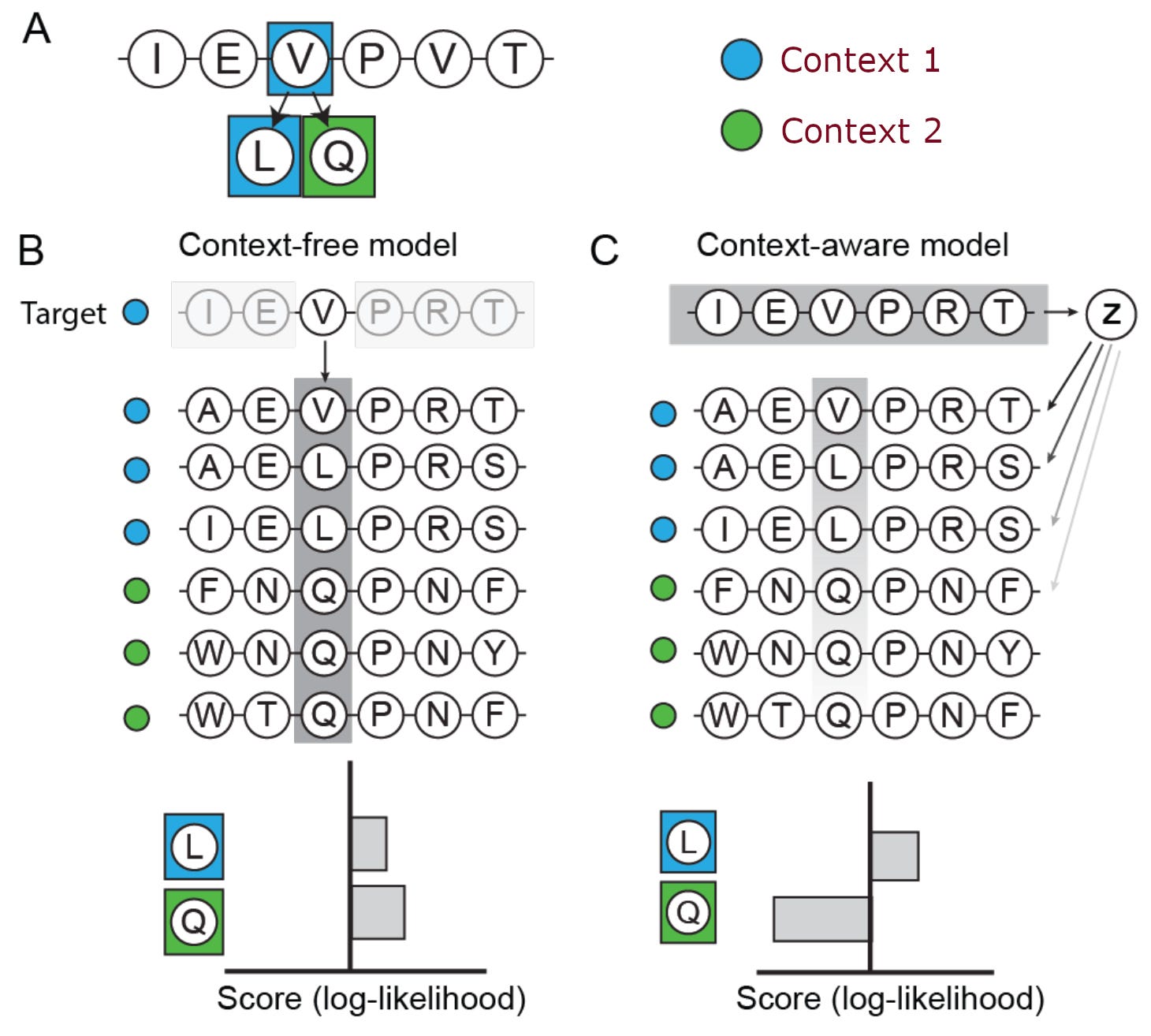
By performing a systematic benchmarking study, Berry et al. find that pLMs consistently do poorly in identifying mutations that enable or increase novel function. My own lab had recently made a similar observation, so this part of the study was not that surprising to me. What comes next is more important, however. Berry et al. show that an alternative model performs much better. What is the alternative model? It is a position-specific scoring matrix (a PSSM, this is basically just site-wise amino-acid frequencies in a multiple sequence alignment) minus a pLM. So, to find variants that generate or improve novel function, we need to look for mutations that are common in multiple sequence alignments, and then among those pick the ones that the pLM thinks are bad. Yes, bad. The pLM score is subtracted, so a high score from the pLM means the mutation is not a good candidate for further exploration.2 This is exactly the opposite of what everybody else in the field has done to date.
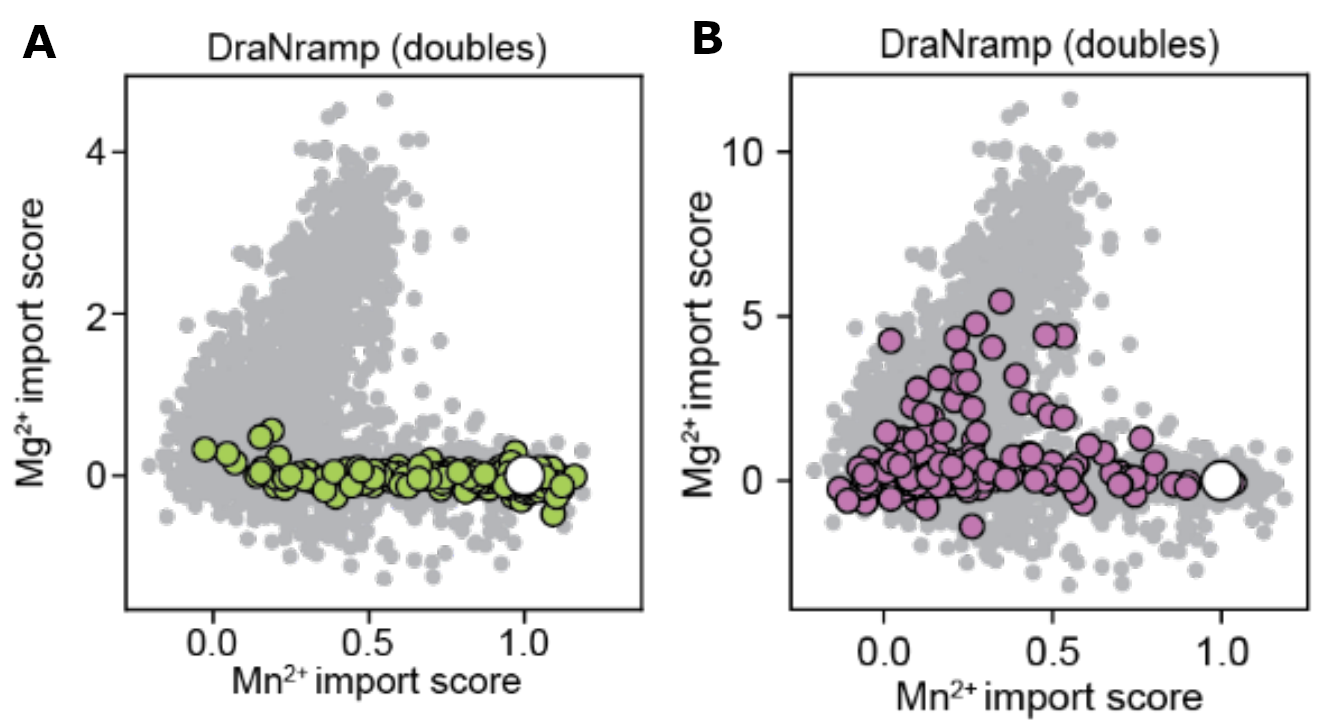
One of the most impressive examples provided by Berry et al. is the case of DraNramp, a protein used by bacteria for manganese (Mn2+) and iron (Fe2+) uptake. In nature, the protein does not transport magnesium (Mg2+), but many laboratory variants are known that can perform this function. So, how well do pLMs such as ESM-1v do at predicting variants that enable magnesium uptake? Terribly. Nearly all of the proposed variants excel at importing manganese, and none can import magnesium (Figure 2A). But, when Berry et al. use scores from the PSSM minus the pLM, they recover many variants that are quite good at magnesium uptake (Figure 2B). The pLM likes to maintain the current function, whereas the PSSM is able to explore new functions.
What is going on here reminds me of the old Jesse Bloom work showing that function-enhancing mutations are often destabilizing to the protein, and therefore more stable proteins are better starting points for the discovery of beneficial mutations.3 Mutations proposed by pLMs are in effect mutations that predominantly maintain or increase protein stability. They fit perfectly into the provided sequence context. The flip-side of this constraint is that they are unlikely to lead to functional improvements. By contrast, the context-free, site-wise models simply propose mutations that are common; because these mutations were chosen without considering sequence context they may decrease proteins stability or otherwise mess things up. But this messing things up may be exactly what we need when we’re looking for new or improved function.
One aspect of the paper that I find unnecessarily confusing is that it conflates sequence context with function. Their Figure 64 suggests that in natural sequences, we see different sequence contexts because they correspond to different functions.5 Consequently, to sample mutations that enable these various functions, we need to somehow break out of the sequence context, and a context-free model does exactly that. The problem that I have with this explanation is that new-to-nature functions cannot be found among any of the natural sequences, by definition. And yet, the natural sequences may well contain mutations that, in the right context, can provide new-to-nature function. The DraNramp example highlights this possibility. Natural DraNramp variants cannot perform magnesium import.6 And yet, they contain mutations that, in the right context, can import magnesium.
In fact, we don’t need to assume different functions in natural sequences. We just need different sequence contexts, which arise for example because of covariation among sites that are in physical contact in the folded protein. We know that contacts create strong evolutionary constraints among sites, visible in covariation in multiple sequence alignments. These constraints are so strong that covariation can be used to identify physical contacts from multiple-sequence alignments. And pLMs have learned this covariation, which we can tell from the fact that we can also use them to infer contacts.7 In other words, pLMs are great at taking into account sequence context. They are literally trained to fill in the blanks given the surrounding context.8 Combine this with reasoning along the lines of Bloom et al., and we should not be surprised that pLMs have a tendency to propose the most conservative, stabilizing, function-preserving mutations, and this tendency goes exactly opposite to what we want when we’re looking for novel function.
Were does all of this leave us? First, the method proposed by Berry et al. is simple to implement. Anybody can use it. So that’s great, we have a new arrow in our quiver. Second, we’ve still only scratched the surface with respect to understanding what pLMs are actually good for. I have no doubt that they are an amazing tool that will have profound implications for the future of protein science. However, this does not mean that these models are currently used appropriately. Clearly, zero-shot predictions from pLMs are not that useful, in particular not if the goal is to find variants that provide novel function. But other pLM applications are totally legit, such as homology search or contact prediction. I’m looking forward to discovering more about how these models work.
More from Genes, Minds, Machines
How useful are zero-shot predictions of mutational effects?

When you read papers about AI models for zero-shot fitness predictions, you generally get the sense that these predictions work quite well. Correlations between measured fitness effects and zero-shot predictions tend to be high. Systematic benchmarks have repeatedly shown this pattern, across hundred of datasets and many different models.
We still can’t predict much of anything in biology

AI has gotten amazingly good for programming. Claude Sonnet will zero- or one-shot small programming tasks without mistakes. And while I don’t think AI is ready to replace software engineers outright, or that vibe coding a fully featured app is a good idea, for simple tasks AI is outstanding. For example, I can perform basic data analysis, maybe visuali…
S. P. Berry, R. Gaudet, D. S. Marks (2026). Differences between protein fitness models can be used to design variants of altered specificity. bioRxiv. doi:10.64898/2026.06.10.731299
The paper does not actually specify the direction of the difference. It just states that the best-performing models consider the difference between the PSSM and the pLM. However, I contacted the authors and asked, and they confirmed to me that the PSSM contributes positively and the pLM negatively.
Reproduced here as Figure 1, but relabeled to remove the confusion.
Berry et al. call them “substrates” in their paper.
According to Sam Berry, there are natural DraNramp homologs that can import magnesium. So this example may not be entirely correct. However, he notes that the argument I make can be correct for other proteins, such as TEM-1. See his response in the comments.
This is the standard pretraining objective of masked language modeling, where we mask parts of the sequence and train the model to predict what was masked. This training objective forces the model to pay attention to the sequence context and complete the masked parts accordingly.
Just glanced, but would be very interesting to look at performance on promiscuous enzymes, and enzymes under diversifying selection for novel substrate activity (eg p450s). Seems like Marks' core point here could be that when stabilizing selection acts on an enzyme behavior, the pLMs pick up on that signature and reject both catalytically implicated and destabilizing substitutions.
I'd also be interested in seeing how this performs with different sequence alignments in the PSSM. Possibly the method works when many related sequences perform the same catalysis and are ingested during PLM training, but then if you broaden phylogenetic scope a bit while making the PSSM you pick up on diversified behaviors with retained folds.
Thank you for the fantastic post on the paper, really glad you found it interesting! My one factual note is that there actually are distant homologs of DraNramp in the multiple sequence alignment I used that transport other ions, including Mg2+, so I don’t see that particular data point as evidence that you don’t need functional divergence in the multiple sequence alignment. I do think, however, that the TEM-1 beta-lactamase dataset likely represents a genuinely new-to-nature activity, since it is tested against a newer-generation antibiotic, and the method does work there. So I think the broader point still stands that it is interesting that the approach can succeed on an activity that was not present in the evolutionary training distribution.
More generally, I personally put a bit less weight on the stability interpretation than you do here. The PDZ3 dataset is the only one where we have orthogonal stability/abundance measurements, and in that case the specificity-altering mutations have approximately the same distribution of stability as the native-specificity mutations. The PSSM and ESM1v predictions also correlate similarity with stability on that dataset. Meanwhile, inverse-folding models such as ProteinMPNN and ESM-IF1 tend to correlate more strongly with stability than protein language models do, but they do not bias against altered specificity to nearly the same extent.
That makes me lean toward the interpretation that the effect is not primarily the PLM learning stability from context but rather learning something about the native function of the wild-type protein from context. For genuinely new-to-nature activities, my guess would be that the model could still be leveraging similarity to natural substrates (for example, other substrates recognized by related natural sequences could share some chemical similarity with the newer antibiotic). But I definitely agree that the data are limited enough that multiple interpretations are reasonable, and I think we’ll need more datasets that measure both stability and specificity to really sort this out.
Also, the labeling in the panel on the right is correct, I will fix it in the next version :)